The CBD industry is expected to expand considerably in the near future. Over the course of the next decade, cannabis-related skin care businesses are expected to reach $25 billion in global revenue. According to market analysis, approximately 15% of this industry is devoted to the beauty business. In recent times, the cannabis industry has experienced a significant extension into several other niches in the market. One of these is the skin care industry, in which some of the most popular and sought after cannabinoids, like CBD, have proven exceptionally useful for dermatologists and patients alike. Even now, clinics and labs continue to test how these components might help skin treatment, which hints that the future of the industry could be even greater than it is today.
As studies have shown, CBD is loaded with anti-inflammatory properties that are very rare and valuable in the medical industry. Dermatologists around the US often prescribe the use of CBD-infused medications and ointments to treat burdensome skin conditions, such as acne and psoriasis. Nowadays, it has become very common to discover CBD among the main components in serums and moisturizers.
However, all things considered, the beauty industry itself is an entirely different aspect that should warrant consideration on its own. Even if makeup formulas were improved substantially with CBD use, it is still too early to tell if it will be a major breakthrough. Could it be possible that CBD delivers great results in lipsticks and eyeshadows just like it does in skincare products?
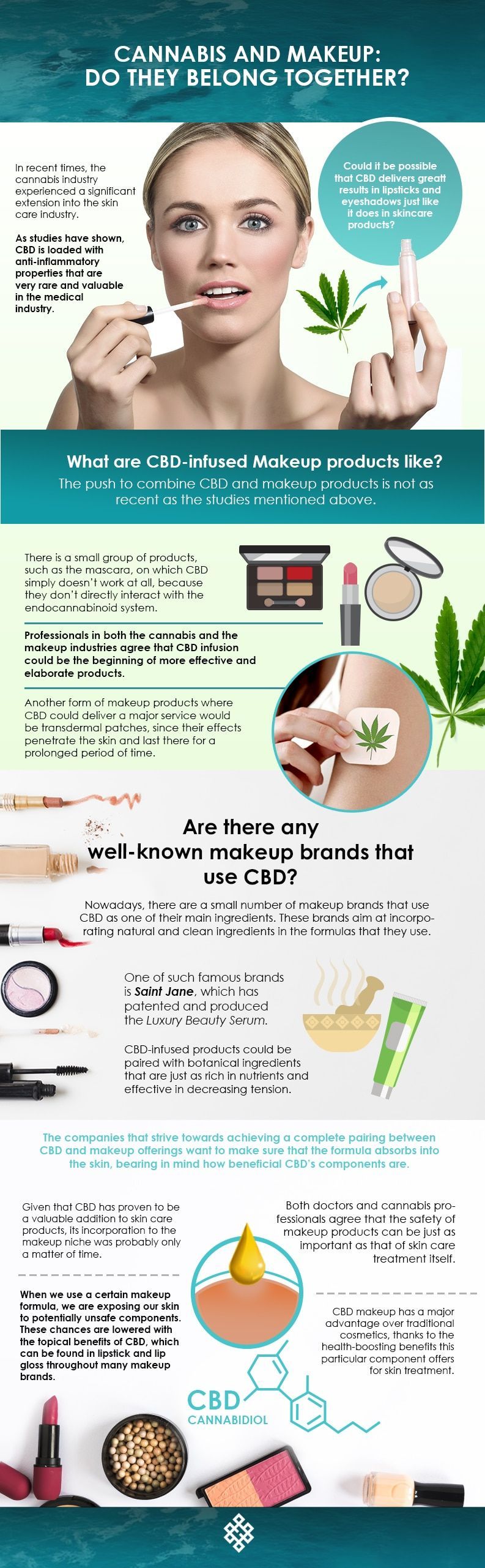
What Are CBD-infused Makeup Products Like?
The push to combine CBD and makeup products is not as recent as the studies mentioned above. Some of it predates even the legalization of cannabis across America. For example, entrepreneurs such as Kimberly Dillon continue to push in favor of cannabis experimentation among makeup brands. Dillon was once one of the directors of Papa and Barkley. She is expected to launch a makeup brand that focuses entirely on CBD-infused offers in the industry. Dillon's involvement in the push for CBD use in makeup products predates the cannabis industry for many years. Contrary to popular belief, she argues, not all makeup products could be reinforced through the use of CBD. There are a small group of products on which CBD simply doesn't work at all. She considers that all skin care products used in the makeup profession would make the most out of CBD infusion. However, the same can't be said about products that don't directly interact with the endocannabinoid system, such as the mascara. Another form of makeup products where CBD could deliver a major service would be transdermal patches, since their effects penetrate the skin and last there for a prolonged period of time. Dillon considers that these types of makeup formulas would be enormously empowered with CBD use, resulting in increased efficacy. Professionals in both the cannabis and the makeup industries agree that CBD infusion could be the beginning of more effective and elaborate products. For example, a CBD primer that penetrates the skin and remains there would be potentially groundbreaking. In summary, according to Dillon, CBD would be the most useful in a makeup infusion as long as it has a clean and transparent formulation. There are makeup products whose ingredients might be counteractive to the properties which CBD has. This, in turn, presents a major challenge for professionals from the makeup industry who want to push for CBD use in products.